


Why Are Some Insects Harder to Kill Than Others?

A cockroach survives an insecticide application. A bed bug disappears into a mattress seam. Meanwhile, another insect exposed to the same treatment dies within minutes. Why such different outcomes? From a pest control perspective, the answer involves more than how tough an insect appears. Biology, behavior, chemical resistance, and exposure all influence insecticide effectiveness. Understanding these differences helps explain why products such as Sterifab, a nonresidual disinfectant and insecticide spray, must be used according to their labeled applications rather than treated as universal solutions.
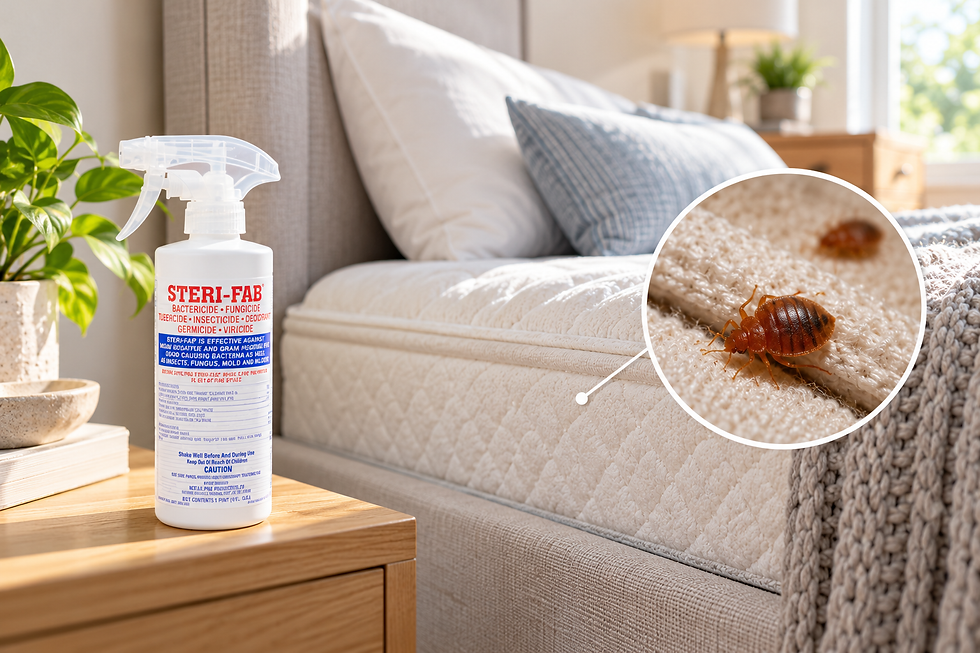
What Makes Some Insects Harder to Kill?
Insects may share basic anatomical features, but their physical characteristics and responses to insecticides can differ considerably.
Most insects have an exoskeleton covered by a protective outer layer called the cuticle. This barrier helps regulate water loss and can influence how quickly certain insecticides penetrate the body. Differences in cuticle thickness, composition, and permeability may affect susceptibility to chemical treatments.
However, a thicker exoskeleton doesn't automatically make an insect harder to kill. The active ingredient, its mode of action, and how the insect encounters it also matter.
Life stage introduces another complication. Insect eggs are often less susceptible to certain insecticides than mobile stages because their protective coverings can limit chemical penetration. With pests such as bed bugs, understanding how an infestation develops through different life stages helps explain why an application that kills exposed adults may still leave viable eggs behind.
Behavior matters, too. Cockroaches spend considerable time in narrow cracks and concealed harborages, while bed bugs commonly shelter in mattress seams, furniture joints, and other protected locations. Understanding where cockroaches hide and reproduce helps explain why these habits can limit exposure, even when an insecticide is effective against the target species.
The important distinction is that an insect can survive treatment without being biologically resistant to the chemical.
Why Insecticide Resistance Changes the Equation
Insecticide resistance is one of the more complicated challenges pest control professionals encounter. It develops when inherited characteristics allow some insects to survive exposure that would normally kill susceptible members of the same species.
Over successive generations, those surviving insects may reproduce, increasing the proportion of resistant individuals within a population.
Several mechanisms can contribute to resistance:
Metabolic resistance: Insects produce enzymes that break down or neutralize certain insecticides more effectively.
Target-site resistance: Genetic changes reduce an insecticide's ability to interact with its intended biological target.
Reduced penetration: Changes in the insect's outer structures slow the absorption of certain chemicals.
These mechanisms help explain why some populations of bed bugs and cockroaches respond differently to particular insecticides.
Resistance, however, should not be confused with immunity. Nor should every surviving insect be considered resistant.
When professionals investigate why insecticides don't work as expected, they also examine application coverage, product selection, treatment conditions, and whether the insect received sufficient exposure.
For example, an insect emerging from an untreated crack several hours after spraying may never have encountered the insecticide at all. Increasing the amount applied would not necessarily correct that problem and could violate label directions.
This is why effective pest management requires identifying the reason for continued activity before changing treatment methods.
Not All Insecticides Work the Same Way
Sterifab is a nonresidual disinfectant and insecticide spray. Learn more about its applications, product characteristics, and how it works.
Why the Right Insecticide and Application Matter
Understanding how insecticides work is only part of the equation. Their effectiveness also depends on whether the product is labeled for the target pest and how it is applied.
Contact insecticides rely on insects receiving an effective exposure through the relevant route. For products that require direct application, insects concealed within inaccessible harborages may remain unaffected.
Residual insecticides, by contrast, are designed to remain effective on labeled treated surfaces for a specified period, depending on the product and conditions.
Sterifab spray works differently. As a nonresidual disinfectant and insecticide spray, it is intended for applications specified on its EPA-approved label, without providing ongoing residual insect control.
That distinction matters when developing a treatment strategy. A nonresidual product should not be expected to control insects that emerge after the application has dried simply because the area was previously sprayed.
Professional pest control therefore involves more than selecting a chemical. It requires understanding where the target insects are located, which life stages are present, and whether the proposed application can reach them.
For established infestations, understanding what to expect after pest control is important. Follow-up monitoring helps determine whether activity is declining and whether surviving eggs, concealed insects, or resistant populations require additional control measures.
Ultimately, the question isn't simply which insects are hardest to kill. It's whether the treatment matches the insect's biology, behavior, and actual exposure conditions.
Common Questions About Insecticide Effectiveness
Does a Larger Insect Require More Insecticide?
Not necessarily. Insecticide effectiveness depends on the species, active ingredient, exposure, and susceptibility. A larger insect isn't automatically harder to kill than a smaller one.
Can Insects Become Immune to Insecticides?
Insect populations can develop resistance through inherited biological changes. However, resistance isn't necessarily complete immunity, and susceptibility can vary between populations of the same species.
Do Insecticides Kill Insect Eggs?
Some insecticides have ovicidal activity, meaning they can kill certain insect eggs. Others primarily target mobile life stages. Effectiveness depends on the product, pest species, and application conditions. Sterifab is labeled to kill bed bug and louse eggs.
Choosing an insecticide starts with understanding the target pest. For labeled insect-control applications, grab a bottle of Sterifab and always follow the product label.


